

Free preview
The shaking is terrible.
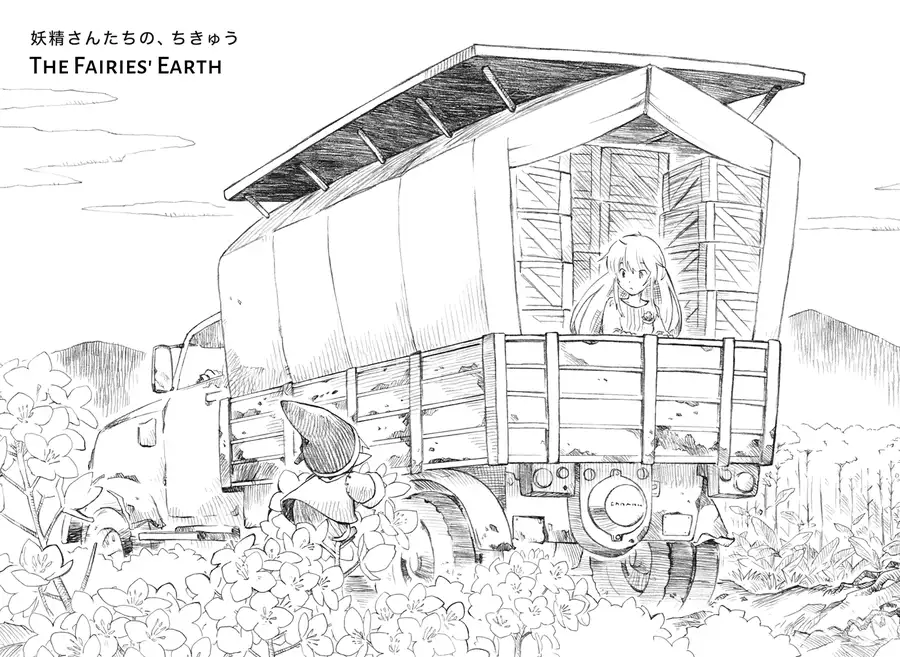
Roads paved decades, perhaps centuries ago, have deteriorated into rough tracks. With weeds crowding in and roots jutting out like bulging veins, the landscape has grown increasingly untamed.
The trailer relentlessly lurches ahead, crushing what little remains of the road under its weight.
This ride is absolutely miserable.
Every time we hit a snag, even the slightest jolt is intensified and shoots straight through to the cargo bed . . . and right into me, squeezed in here among the wooden crates.
I curse my own stupidity for thinking that riding in the cargo bed would somehow be comfortable.
Traveling on a flower-lined road should be pleasant, but the pain in my rear is ruining it for me.
I feel an awful lot like livestock being hauled to market.
If I'd just taken the passenger seat . . . no.
I begin to mutter but immediately dismiss the thought. Sitting in the passenger seat would mean being trapped in a conversation with the caravan leader behind the wheel. That would be absolute torture for someone as easily flustered and prone to mistakes as I am.
Between my pride and my backside, I figured the latter could handle a little more punishment.
Even so, I've finally reached my limit.
After taking a deep breath, I call out to the driver.
How much longer until we 'rive . . . ?
I'm stumbling my words a bit, but since he doesn't seem to notice, I decide not to correct myself. I really am hopeless at talking to strangers.
Three, four hours maybe. Long as the sun don't disappear on us.
Without a backward glance, the leader, as firm as a rock, replies.
I give a brief thanks and let my mind drift to the crude solar cell module jutting out like an umbrella over the canvas cover.
This trailer seems to be a rare hybrid vehicle, using both fuel cells and solar power. It is valuable simply because it is still operational, though it likely relies on only one energy source for everyday use.
I suddenly feel a bit anxious.
Since I'm getting a free ride like this, I have no right to complain.
We continue crawling along at a speed of about eight kilometers per hour.
Four more hours . . .
Humming drifts back from the driver's seat.
Driving while bathed in gentle sunlight looks pleasant enough.
When I finally can't bear the pain in my rear any longer and try to lift up . . .
Best not to stand up. Had someone fall off that way before. Just so you know, guy got caught in the wheels and died a slow death.
I promptly sit back down.
To distract myself, I gaze at the flowers growing wild along the roadside.
Mostly, all I can see is yellow canola flowers.
They're useful plants, good for making oil or pickles. But when you get close, they're covered with aphids, so I no longer feel like diving into them the way I used to as a child. A maiden's heart grows jaded, you see. Much like my current annoyance with this cargo bed.
Ignoring the throbbing pain in my butt, I stare absently at the scenery until some little heads pop up from the flower field.
. . .
Our eyes meet.
For about a second, maybe?
They quickly duck their heads back down, as if escaping.
Well . . .
I haven't seen them since childhood.
It was so sudden, lasting only an instant, but there is no way I could have mistaken what I saw.
They are unforgettable once you've seen them.
I even forget the constant ache in my rear and start smiling.
So they live in places like this too.
Though they're believed to inhabit every region where life is possible, they rarely show themselves to humans. This unexpected encounter seems like a sign of good fortune to me.
I must keep the peace with them.
It's something like an obligation I bear as the final graduate of my school.
Leaning against the edge of the cargo bed, feeling the gentle wind on my cheeks, I get lost in nostalgia.
The graduation ceremony was three days ago.
The venue was a dilapidated auditorium.
One might think it's dangerous to hold a ceremony in such a place, but rest assured.
The deterioration had progressed so far that there were hardly any ceilings left to collapse or stone walls left to topple over.
When we entered the ceremony hall, we found twelve chairs clustered together on a floor polished so thoroughly that not a single grain of sand had been overlooked, and we stood there stunned for a moment.
The cool fragrance from the fresh flowers pinned to our chests made my nose tingle. Until these flowers wilted: that was how much time we had left as students.
Just graduate and go home.
I thought I was handling this pretty well, accepting it as a simple fact of life. But the moment I stepped into the auditorium, everything around me seemed to blur.
A premonition shot through me. This wasn't going to end here.
The ceremony had numerous attendees besides the faculty.
However, you could barely spot any relatives of the graduates among them. We had all left our distant hometowns behind to attend the school, living in dormitories.
Most of the attendees were education-related personnel connected to the school.
Both the professors and attendees outnumbered the graduates.
Surrounded by all these people, we felt the pressure from every direction as the ceremony began.
Before the ceremony, all of us had made a pact: no crying.
Breaking down in front of so many guests seemed embarrassing for those of us who were finally becoming adults.
With only twelve graduates, the ceremony should have been over quickly.
However, the faculty lined up in a row across the stage and had each graduate stand on the platform one by one. With deliberately leisurely attitudes and carefully chosen comments, they conducted the diploma ceremony with meticulous care to the live performance of Chopin's farewell song.
They made everyone cry. It was inevitable.
The gist of the comments was simple.
If the faculty had used a summary sheet, it could have been summed up in one phrase: "share memories with that student."
Everything else was pure artistry.
The word choices were cunningly perfect, diverse rhetoric sparkled and dazzled, inverted expressions cleverly disrupted our expectations, and just when you thought they were depicting reality with cold precision, they'd have personified elements of nature perform every kind of lyrical flourish. The silences between sentences would communicate volumes instantly, and soon, the simple, heartfelt congratulations would possess the enduring beauty of poetry . . . All of this would blend together seamlessly and gently, just as the graduates standing on stage became unexpectedly teary-eyed.
They were clearly aiming for this.
I was defeated in less than a minute, but the other graduates fared little better.
Even Friend Y, who absolutely hated showing emotions in public, was teary-eyed behind her glasses when she returned from the stage.
I think it was the faculty's secret revenge against the students who had given them so much trouble. It seems entirely plausible to me.
When this official bullying ended, we all held spotlessly white, gleaming diplomas in our hands.
More than ten years spent there, learning various things, experiencing different things, all of it for this single piece of paper. But with the diploma's feather-light weight, it all felt anticlimactic.
We pressed the wilted flowers as keepsakes in the photo albums we received. Photographs aren't even available to ordinary people nowadays. Though flipping through them could evoke those times endlessly, even now, the memories were taking on an ephemeral quality.
The melancholy exploded at the farewell party held right there in the auditorium.
Since it's chaotic precisely because it can't be fully described, and since I'm a recorder with no intention of fighting against that chaos, I'll limit myself to listing only the essential elements.
It consisted mainly of the following:
Unprecedented delicacies being carried in. Colorful fruits rolling across the floor. What seemed to be someone's homemade party crackers. Champagne corks bursting through the air. Impromptu piano performances. Graduates shouting at the top of their lungs. Graduates crying. Graduates laughing. An overhyped graduate whose persona had spun completely off track from overexcitement (that would be me). Friend Y's red, swollen eyes when she returned from the restroom about ten minutes later. Elderly guests sharing drinks. Male graduates with drinks being poured from both sides without pause. The raspy tone of a jazz trumpet. A strange elderly woman taking my hands while crying. A ragged chorus. Tears flowing freely from elderly and graduates alike. The hour and minute hands overlapping to mark midnight . . .
This school was humanity's last educational institution.
Former universities, former cultural associations, former private organizations . . . the school was born as a unified institution from these more than a hundred years ago, they say.
Such mergers of educational institutions were scenes witnessed around the world as population declined at an accelerating rate.
When population decreases, so do children.
The number of students became insufficient.
So merging with other educational institutions to expand school districts and academic fields became a frequent occurrence.
After that, it was all downhill.
Fifty years ago, it had already become commonplace for children from around the world to gather in towns with schools and receive education while living in dormitories.
With the graduation of us twelve, the school, called humanity's last educational institution, also reached its closure.
From now on, education will probably return to something passed down from parent to child.
And now, here I am, making my way home while nursing a sore rear end.
A large shadow looms ahead, blocking our path.
The great camphor tree. This tree is etched in my childhood memory, so I recognize it instantly.
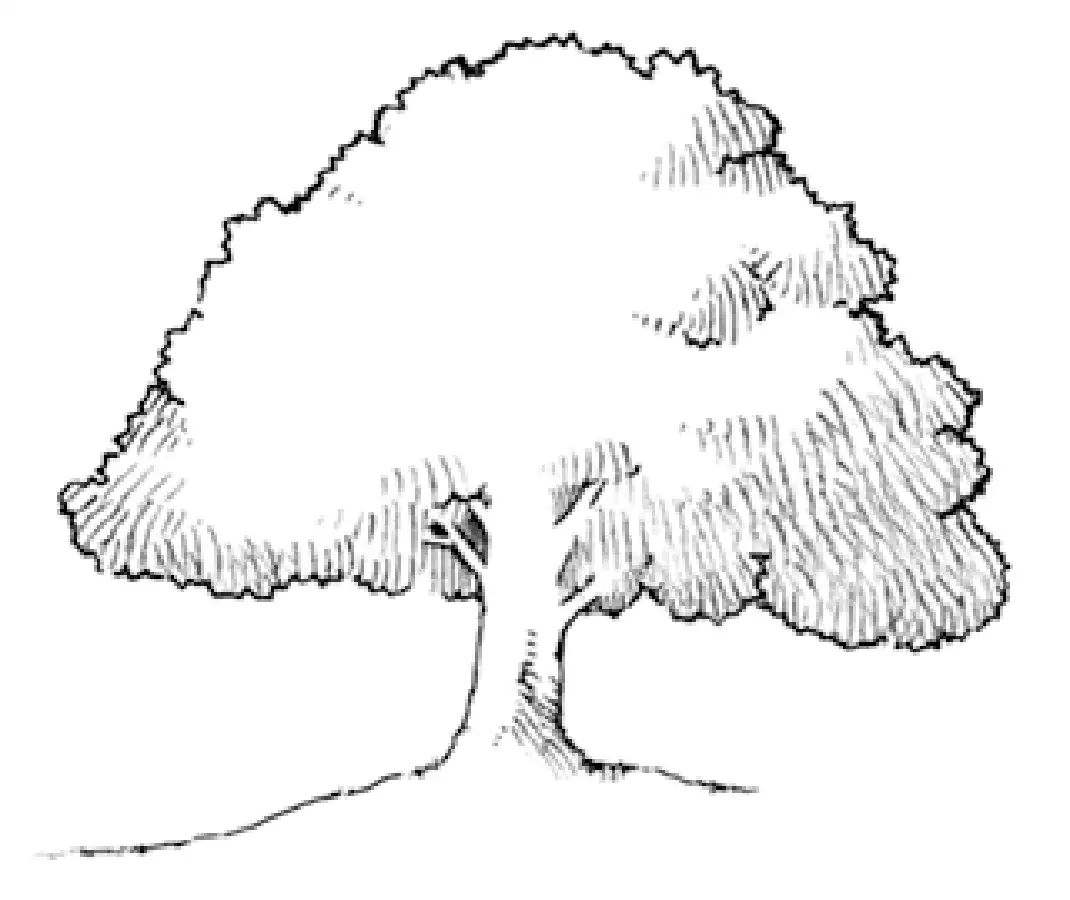
It's like a landmark separating the village from the outside world.
Here, where only the occasional ruined house punctuates the overgrown wild grass, it stands out strikingly, as if it were added in as an afterthought.
From the village to the camphor tree is about a three-hour journey for a child. All the village children used to make this tree their destination for outings.
With this trailer, we'll need about two more hours if we're lucky.
I lean back against the luggage and let the tension leave my body.
A new life awaits me in the village.
Since I decided to work in the village after graduation, I have resolved to embrace the challenge.
The time has come to put to use the various knowledge and skills I've gained through more than ten years of continuous study at school, beginning with cultural anthropology. I'm still quite immature as a scholar. That difficult path inevitably demands youthful strength, allowing no compromise, concession, resignation, or laziness. After all, without the most rigorous spirit of inquiry, one can never hope to reach the summit. But I have the ambition to fulfill myself as a young researcher. I have youth. I have the opportunity to make it happen. It seems to me that pressing forward is the only path I can choose.
Though it would certainly be better if I could achieve my ambitions the easy way.
The moment we turn onto the side road, the vehicle's vibrations stop completely.
We must be in Camphor Village. As I'd expect, inhabited land has level ground.
Mmnh . . .
I had been sleeping crammed between wooden crates with a wet towel over my eyes, but I could sense the difference in motion.
I seem to be more exhausted than before I slept, though. I can't even summon the strength to open my eyes, let alone sit up.
I grope for the edge of the cargo bed and use my arms to pull myself upright.
Mmmnh . . .
Writhing around like an inchworm, I finally manage to cling to the edge, gasping for air. The jostling is making me nauseous, and I have a sour taste in my throat.
I lift my face like I'm doing a pull-up, rest my chin on the edge, and finally open my eyes.
The trailer is weaving its way between houses now.
There are fences within arm's reach. Even the main street looks too small for this big vehicle to drive through.
Ah, the time is finally approaching when I'll be reunited with beloved solid ground.
Having recovered some energy, I glance around at my surroundings.
Houses in good condition stand huddled together, and several retrofitted tin chimneys are billowing thick smoke. Cooking time, no doubt.
Houses with people living in them are easily recognizable because they're generally painted in bright pastel colors. No matter how good their condition, many are centuries-old deteriorating properties. Without paint, the exterior walls eroded by acid rain would be hideous.
Pastel Houses have become something of a fundamental cultural landscape for people in this era.
The scenery before me matches up perfectly with my childhood memories that come flooding back.
One house in the village painted entirely pink.
The community center I hung out at for picture books and games.
The soft milky-white house where an elderly woman who enjoyed baking lived. When children brought ingredients to her, she'd make all sorts of treats for them.
The trailer rolls carefully toward the plaza.
The plaza is a circular clearing created by demolishing several buildings. Looking that way, I soon see a large crowd already waiting.
Oh no.
I immediately feel my nerves get to me and pull my head back.
I'm strangely reluctant to reunite with old acquaintances. I was already terrible at speaking in front of crowds. I wanted to handle greetings individually, one person at a time if at all possible . . . But the caravan continues to attract everyone's attention as it advances its massive bulk to the village plaza and comes to a stop.
Looking for a spot hidden from the rear loading platform where unloading would presumably take place, I slide into the space between the wooden crates and the side rail. It's perfect. If I sit with my knees drawn up and keep my head low, I should be hidden. I'll stay here until things cool down.
But the world isn't quite so accommodating.
The metallic sound of a crank turning announces the side rail lowering. Squeak, squeak. It's the very section I'm hiding behind. The gazes of people gathered to receive their supplies all pierce through me at once as I come into view, balled up over my knees.
A pipe drops from the mouth of the man in front.
The trailer can apparently open from the sides as well as the rear.
A middle-aged woman with a familiar face makes a sound. Just as I remember her, she remembers me . . .
Aren't you . . . ?
I quietly bury my face against my knees.
Having thoroughly embarrassed myself at the plaza, I drag my completely worn-out body and mind to my front door.
I'm home . . . Grandfather?
From inside the dim house, Grandfather emerges carrying a hunting rifle, dressed in the same white coat I remembered. I'm quietly relieved that there is no sign of aging in his brisk stride.
Oh, you finally made it back.
Grandfather, who is large for an elderly man, places his hand on my head despite my being quite tall for a woman.
Hmm, you've gotten taller.
Well, it has been years . . .
Incidentally, over these past few years, I've shot up like a bamboo shoot. To the point where being any taller would be a bit of a pain . . .
Good complexion, too. What about carrots?
I still hate them . . .
Grandfather snorts at my reply.
What's this? Haven't grown much on the inside, then?
I think I have . . . probably.
Well, come inside. I was just thinking of having a meal.
Huh? You're going hunting now?
I eye the hunting rifle in his hands.
Don't be ridiculous, not this late. I was just tinkering with this old thing to give it more punch.
Grandfather loves guns.
Did you come with the caravan?
Yes.
I decide not to go into any more details than that.
Oh, and Grandfather. I'm sure you've heard, but I'm going to become a mediator like you, and—
I've got some good watercress. It goes great with fried food and bread.
My passionate reveal of my future goes right in one ear and out the other.
The dining table is set with vegetable and dried meat soup, various dishes like fried fish, vegetables, and pickles, plus a basket of sliced round bread for making sandwiches.
Grandfather had prepared all of it.
Having lived alone for many years, Grandfather has become quite the cook.
He prefers hearty dishes like whole roasts and smoked meats, but occasionally he'll make lighter soups for me. That familiar aroma brings back so many memories.
While carefully assembling a pickle-loaded sandwich just the way I like it, I chat with Grandfather as he sits across from me.
I see, so the school system has finally come to an end.
Yes, so many people came to the farewell party . . . I was surprised.
That's how these things go. When ours closed down, people from all over came to see it off . . . What's this? You still haven't broken that habit of yours, I see.
Five assembled sandwiches are lined up in front of me.
I can't concentrate if I try to eat while I'm making them . . . Is that weird?
No, it's fine by me.
When I make things, I tend to get completely absorbed in them.
It's a habit of mine that my friends call a "homework compulsion," and my family calls a "setting up shop compulsion."
Can you even eat all that?
No way. Obviously.
I says this without the slightest shame.
Dummy.
Grandfather's hands swoop in and confiscate two of them.
You've grown taller, but you're still the same weak little creature as always.
Please call me civilized.
Formerly. Formerly civilized. There's hardly any civilization left anymore.
Come to think of it, that was my first time riding in a solar-powered trailer.
That thing. No speed, no horsepower, and once it breaks down, it's pretty much done for.
Fortunately, I made it back without it breaking down.
The caravan folk have plenty of nice toys. You should have gotten a job with them instead. Looks fun.
Oh, no . . . I can't do manual labor.
Grandfather's expression turns as if he just remembered something.
Are you really going to work for me? It's not like you have to inherit this job.
That's my plan. I went to the trouble of getting a degree, and you're maintaining the office, aren't you? I think it's good to have an officially recognized place like that.
What an eccentric. A mediator of all things.
I think it's work that suits me.
Oh? And the reason?
Easier than farm work, I guess . . .
My true feelings just come pouring out during this long-awaited family gathering.
For such a reason . . . ?
Grandfather sounds exasperated.
I give him a sharp look and make my grand declaration.
You know perfectly well that I have a weak constitution, don't you, Grandfather?
No, you just said you want to take it easy.
Did I say that . . . ?
Well, in times like these, agricultural and livestock training is included in the basic educational curriculum . . . and that was terribly difficult. Compared to that, being a mediator is work that even elderly people can handle just fine, so it shouldn't be hard on me physically.
I find I can drop my nerves when I'm talking with family.
My granddaughter has come back a weirdo.
Hey!
Honestly, you're not physically weak, you just lack willpower.
Yes . . .
If you keep taking it easy all the time, you won't have any backbone when you get old.
Yes . . .
Well . . . a month from now, if you haven't changed your mind, I'll be impressed.
Is it tough work?
Of course, after getting my mediator certification, I researched the job thoroughly. From what I found, it seems much easier than agricultural work and other manual labor needed to be self sufficient . . . but maybe the reality is different?
Grandfather answers my doubts with a single phrase.
Depends on the person.
I cock my head. Hmm, is there some kind of demanding physical aspect I've missed?
Well, just try letting them walk all over you once, my hopeless granddaughter.
That's mean of you to say.
Well, for now anyway. Come to the office tomorrow. I need to set up a place for you.
And the matter's settled.
When I wake up on my first morning back home in over ten years, it's already eight o'clock.
Oh no . . . !
I've completely overslept. The travel fatigue must have caught up with me. I mean, honestly, how can I not be exhausted?
I scramble out of my room and peer toward the kitchen.
Grandfather is having his breakfast.
What's all the commotion?
Ah . . . good morning . . .
Mm, good morning.
And he just keeps on eating, calm as can be.
This is strange. Really strange. I'm left speechless, standing there stunned for a moment, with this nagging worry that I've somehow messed up.
What are you doing?
Wait, but . . .
Having lost my parents at an early age, I lived with Grandfather since childhood. His approach to my upbringing was quite strict—if i overslept and missed breakfast, I’d inevitably get a bonk on the head. So what does this mean? Did he forget? Even if I broke my six o’clock curfew or forgot a single chore, I always got bonked without fail. Has he really forgotten . . . ?
I'm heading out soon. What are you doing? Weren't you supposed to go to the office today?
Ah, yes . . . I was planning to.
A meal has already been prepared for me. I haven't experienced this kind of scene in ages, so I decide to eat gratefully.
So, what will you do? Leave with me, or take the day off?
Um, would it really be okay to take a day off?
Wouldn't that go against his usual strictness?
But instead, he gives me a rather matter-of-fact answer.
There's no need to rush back to work the day after you just returned. I heard enough last night to know you're too weak, anyway. Your complexion doesn't look good either. Makes sense you're feeling rough after being jostled around like that for hours in the cargo bed. I hear you sat there with your knees drawn up and didn't move an inch, just like a piece of luggage—
I want to scream, "No way!"
Just as I'd expect from Camphor Village, a backwater at the very edge of the trade routes. Even in an era when personal communication devices aren't readily available, information has spread instantly through good old fashioned word of mouth.
My h-health is p-perfectly fine . . .
I suppress my agitation and . . .
I'm sickly, you see . . . yes, I'm a sheltered, unfortunate, melancholy young lady. So today I'll be taking a personal day.
I declare proudly.
. . .
Oh no, he's looking at me with those pitying eyes of his.
I-Is that . . . a problem?
No. It would be nice if there were a job for a sheltered, unfortunate, melancholy young lady. Something like counting fallen leaves by the window.
There isn't one like that?
I'll look into it.
But it would be nice, wouldn't it? Like sanatorium literature?
I guess if we're just talking about appearances, that's not entirely wrong.
I definitely look the part.
My shy personality only reinforces this image, and I have completely cornered the market on being a "quiet, refined young lady." Since kids these days are generally pretty tough, my monopoly on this role is unshakeable.
Of course, once people get close to me, my true nature eventually finds its way out. My sharp-tongued Friend Y, for instance, has no qualms about calling me a "walking fraud."
Well, that's fine by me.
Grandfather drains his tea.
I'm heading out now. You come by later, if you feel up to it.
Yes, I'll do that then.
You still remember where it is, don't you?
Um, that building shaped like stacked pancakes, right . . . ?
That's right. I'll be there until noon today, so come by then if you feel like it. Soak the dishes for me.
He quickly throws on his white coat and makes a brisk exit.
After he's gone, I can't help but stand here dumbfounded and bewildered.
It looks like in the end, there is no physical punishment for oversleeping.
Having been raised from childhood on a strict policy of "no reward, inevitable punishment," never being praised for achievements while always being punished for wrongdoings, I feel completely unsettled by this turn of events.
Grandfather has always been merciless.
Yet look at this leniency!
Not that I want to be punished or anything, but . . .
I finish my breakfast, still feeling completely unsettled.
Now, what should I do?
I hesitate to rush out immediately. I need some time to process the bewilderment churning in my chest.
For now, I soak the dishes in water and explore the cramped house.
My nostalgic home.
My home that looks the same yet is different in minor details, with wall stains, decorations, and the like.
I have a pleasant time comparing the past and present.
After fifteen minutes of walking through the farm paths . . .
Here stands the large building shaped like a circular arena, the Camphor Culture Center.
Grandfather, who belongs to an organization called the United Nations Mediation Council, works in this pancake-stack building. He divides his time between hobbies, hobbies, hobbies, and official duties, in roughly a 3:3:3:1 ratio.
Like the Colosseum in some far-off land, the upper portion is partially collapsed with missing sections.
Even so, it's a rare large-scale building that's being put to good use due to the relatively little damage it has sustained over the years.
Officially, The Culture Center was the building's original name.
It was probably used to bring culture and enlightenment to the local residents.
Due to its spaciousness and numerous rooms, it's now being used as an office building. University labs, research facilities, business offices, religious organizations, warehouses, you name it. It's being put to all sorts of uses. Though I'm told it was packed to capacity over fifty years ago.
Currently most rooms are either vacant or abandoned after their occupants disappeared, making it a perfect playground for the local children.
Excuse meee . . .
I open the door, which has long since lost its glass and become nothing more than shabby wooden planks, and step inside. The dim hall is not only covered in dried grime, but for some reason there's a single shoe on the floor, giving the whole place a distinctly desolate feel.
Naturally, the reception desk is unattended as well.
I climb the spiral staircase that winds upward like a corkscrew and head for Grandfather's third-floor office.
Even though it’s called the United Nations, Grandfather has been the only local staff member until my arrival.
If something happened to Grandfather, the UN position would have gone unfilled. These days, there are countless facilities that shut down for exactly that reason.
Just what you'd expect in this age of decline.
They can't be bothered with the finer details anymore. Everything's gotten so sloppy.
Ah, here . . .
United Nations Mediation Council.
I find the room with that nameplate and knock.
And nothing . . .
Hello, anyone there?
I try knocking once more, but there's still no answer.
It seems like no one's here at all.
I sigh and gently turn the doorknob. Even though I'm not doing anything wrong, I feel a little nervous.
Grandfather . . . ? Wait, whoa . . .
I'm stunned by what I see when I step inside.
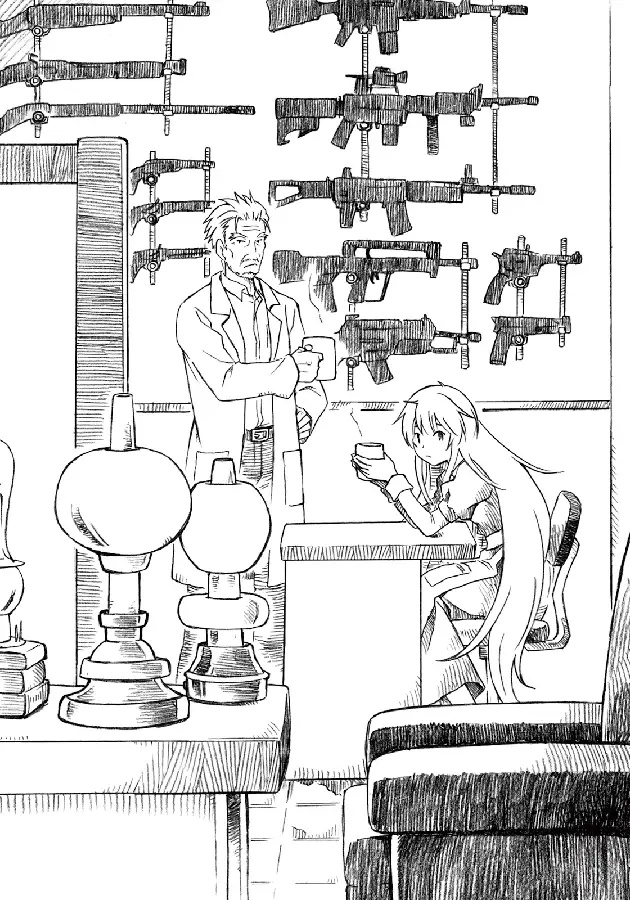
Various guns are displayed along one wall, covering it up entirely.
They are obviously personal belongings.
And maybe it's just my imagination, but I swear the smell of gunpowder has seeped into the entire room. Though surely that would be crazy . . . right?
Aside from that intimidating collection of weapons, it's at least a proper office.
There are dark gray floors with peeling linoleum, three office desks scattered around the room, and in one corner, a small partitioned area with a complete set of reception furniture.
Only one desk shows signs of use, probably Grandfather's. I can tell because documents are stacked high and cups, pen holders, memos, and other items are scattered across it in complete chaos.
Looking more closely, another desk also shows signs of use. This one is strangely tidy, with just a few paperback books and a pen on its surface. Someone's probably using it, though it doesn't look like they're doing any real work. Or maybe Grandfather just uses both desks.
The last one is brand new, a desk that's never been used.
Well, I suppose that would be my territory.
So much dust . . .
It looks like my first day will be spent cleaning this desk.
Still, compared to farm work, this is a breeze, so I'm not complaining.
The reception area's furniture has become storage for oil lamps, the main light source at night, which pretty clearly shows how few visitors we get.
For now, I sit down in the chair, completely at a loss for what to do.
Well then, what should I do, hmm?
Glancing around, I notice a door to another room at the back of the office. The moment I spot it, the door opens and Grandfather emerges.
Oh, you're here.
Hello.
That seat you're sitting in now, that's yours.
He gestures with his chin, just as I expected.
Yes, I'll take it.
Congratulations on your appointment.
Heh.
Grandfather grins.
Ah, thank you.
I'll make you some tea. Oh, the plumbing here is hit-or-miss, but it's just rainwater from the roof tank, so you can't drink it anyways. We usually just bring our own drinking water.
But when you say "we," it's just been you here alone, right, Grandfather?
With you, that makes three of us.
He says this and heads back to the room he came from, which is apparently the tea room.
Here.
Thank you.
I take the tea from Grandfather as he returns.
Wait, three? You mean two, right?
Hm? Didn't Okuzuki tell you?
Okuzuki is a UN staff member.
She's an alumna from my school who helped with my career counseling. Unfortunately, we've only exchanged letters, so I've never actually met her.
Tell me what?
About the assistant.
Huh? I'm getting an assistant already, on my first day?
Don't be stupid. He's MY assistant.
Ohh.
Well, that's caught me off guard.
So there really is a third person after all.
Talk about throwing a wrench in my plans.
I thought you knew about this, but do you still get, what do you call it, stage fright around people?
It's not exactly stage fright, but . . . um, first. That assistant is an elderly lady or something, right?
Nope, he's a young man.
Ahh . . .
My voice sinks, as if a bucket of sadness has been poured over me.
The school was coed, wasn't it? What are you so afraid of?
This society has an ultra-low birth rate. I was in the very last class. There wasn't anyone of the opposite sex even close to my age. The nearest was four years younger . . . and even then, it took me several years to get used to those kids.
Don't worry. He's quiet and completely harmless.
No, that's not really what I'm worried about . . .
If it's really too much for you, you could use a separate room.
He points to the other side.
It's cramped, but there's enough space for one person to work.
No . . . getting special treatment like that would also be a bit . . .
What a difficult grandchild. Are you really that hopeless with people?
Well, you see, it's not that I'm hopeless exactly, but . . . I'm just not very good at dealing with people.
Hahhh.
I take a deep breath to clear my head and lightly slap my cheeks.
Fine, I understand. Let's just call this the price of a laid-back office job, and I'll keep up my sheltered young-lady act at work.
What exactly does that strategy accomplish?
People will see me as the quiet type, so they won't try to talk to me much.
What a boring life . . .
Oh, leave me be. Anyway, he doesn't seem to be here right now.
Ah, a doctor came with the caravan, didn't he? He went for medical examinations.
Is he in poor health?
That's right. He's genuinely frail. Since we need to divert power to the hospital, we'll be conserving electricity around here for a while.
These days, not all places get reliable electricity.
They said it's going to be a hospital stay for testing, so he won't be back for a while. Use this time to finish feathering your nest, make yourself a mental safe haven or something.
You make me sound like some kind of bird . . .
Oh? So you're good with where your desk is positioned? Your desk and his desk face each other, so if you leave it like that, you'll be staring at each other every day.
Absolutely not. I hurriedly start looking for a better desk position.
Ideally, I want a spot where no one can see me, but I can monitor everyone else. At school, my height always put me in the back row, which was comfortable.
Ah, over there looks nice . . .
I think wistfully while looking at the reception area.
Grandfather, inside that partition . . .
That won't work. That's the reception room. Clients do come occasionally.
But it's being used as a lamp storage area.
When clients come, we can just move the lamps. Anyway, the reception room is off-limits. Run-down offices have more atmosphere when they have those narrow reception rooms partitioned off like that.
That's some strange reasoning . . .
Grandfather has very particular tastes.
That's right. You won't need to handle documents and such until I hand things over to you. Today you can take your time thinking about where to settle in.
Yes . . .
If you feel like it, why don't you go greet them as the new appointee while you have the chance?
Oh, that's something I have to do, right?
No, you don't have to.
My eyes widen.
Why not?
That sort of thing is up to the person in charge's discretion. If you don't think it's necessary, that's fine. It's your choice.
Freedom!
But wouldn't that be problematic in terms of work responsibilities?
As if sensing my doubts, Grandfather continues smoothly.
This job has extra stuff to do if you're interested, but mostly it's just paperwork.
Then what about the mediation work . . . ?
Their affairs are their affairs. There's actually almost nothing we need to do on our end. When this department was established, there were apparently still lots of problems cropping up, but now mediators are just like decorations.
I see . . .
I absorb his words in a daze, like drinking flat soda.
Good for you, though. Easy work, just like you wanted.
It's not like that, I simply want to choose an appropriate job considering my physical capabilities. Farm work involves manual labor, sun exposure, and bugs that I dislike, so I just want to avoid anything unpleasant like that.
Any way you put it, those are the words of a lazy person. Well, I do agree that farm work is boring.
Right? Right?
After all, Grandfather is a man who enjoys the finer things in life.
Real food should be hunted, that's the only proper way.
He's a hunter-gatherer at heart.
I'd rather just be a consumer . . .
People like you are what's destroying civilization.
Ouch. That stings.
Look, if there were no other way to eat, even I'd plant seeds. But since there are still these nice, cushy jobs available . . .
Fair enough, but . . . hmm.
Grandfather strokes his scruffy beard with amusement.
You know what? I take that back. You could stand to suffer a little after all, young lady. Go introduce yourself to them. Director's orders.
Right, I suppose introductions are important.
Now that I know there's actually someone out there to deal with, the office suddenly feels more serious. The thought of some actual fieldwork doesn't seem so bad anymore.


